Most people pick a bedtime the same way they pick a random seat on an empty bus – they just go with whatever feels okay. And then they wonder why they wake up groggy at 7 a.m. even after getting a full eight hours. If you’ve ever lain awake at midnight thinking “what time should I go to sleep, really?” – the answer isn’t always about how long you sleep. It’s about when your body naturally wants to sleep – and whether you’re working with that rhythm or against it.
Why “Just Sleep 8 Hours” Is Incomplete Advice
You’ve probably heard it a hundred times: adults need seven to nine hours of sleep. The American Academy of Sleep Medicine (AASM) and the CDC both back this recommendation, and they’re not wrong. But that number is only half the equation.
The other half is timing.
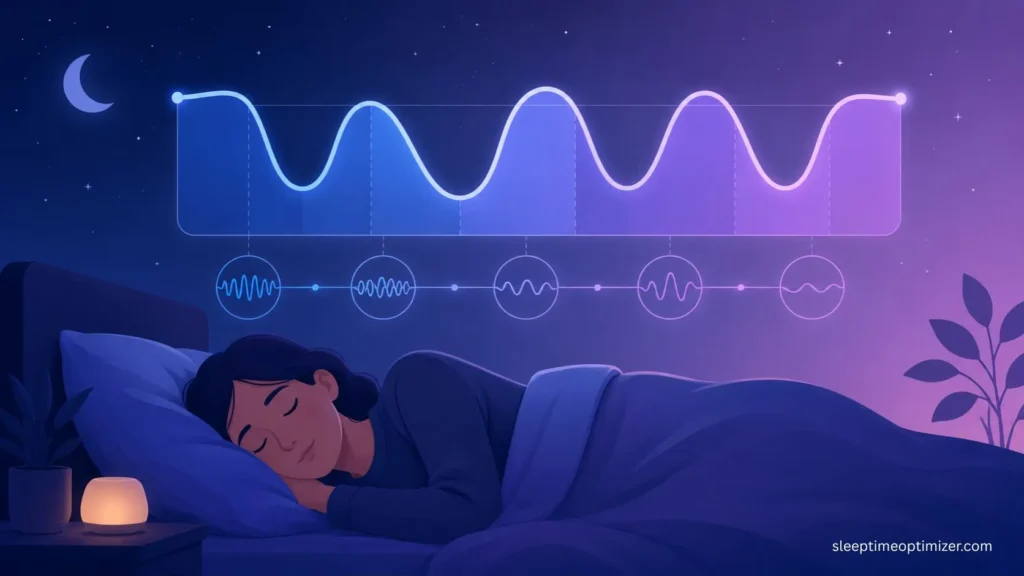
Your body runs on a roughly 24-hour internal clock called the circadian rhythm. This clock is regulated by light, temperature, and a hormone called melatonin. When daylight fades, your brain starts releasing melatonin, signaling that it’s time to wind down. If you go to bed when your melatonin is already rising, you fall asleep faster and cycle through your sleep stages more efficiently. If you fight that window – say, by staying up scrolling your phone at midnight – you’re essentially rowing against the current.
A 2020 study published in Current Biology found that people who slept at socially misaligned times showed increased depression symptoms, reduced wellbeing, and greater fatigue – even when total sleep hours were the same as people who slept in sync with their natural rhythm.
The Sleep Cycle Factor
Your sleep doesn’t happen in one long, uninterrupted block. It cycles through four stages roughly every 90 minutes: light sleep (N1 and N2), deep slow-wave sleep (N3), and REM sleep. Each full cycle takes between 90 and 110 minutes, and a healthy night involves four to six of these cycles.
Here’s the part that matters for your bedtime: waking up mid-cycle – especially during deep sleep or REM – is what causes that horrible “I’ve been hit by a truck” feeling in the morning. Waking up at the end of a cycle, when you’re naturally in a lighter stage, is when you feel refreshed and alert.
So, the goal isn’t just “get enough hours.” It’s “wake up at the right point in your cycle.”
Example: If you need to wake up at 6:30 a.m., count backwards in 90-minute increments:
- 6:30 a.m. → last cycle ends
- 5:00 a.m. (4 cycles = 6 hours)
- 3:30 a.m. (5 cycles = 7.5 hours)
- 12:00 a.m. / midnight (6 cycles = 9 hours)
That means your ideal bedtimes are around 9:00 p.m., 10:30 p.m., or midnight – because those windows let you complete full cycles before your alarm goes off. And that calculation is essentially the answer to what time should I go to sleep for your specific wake-up.
How Age Changes Your Ideal Bedtime
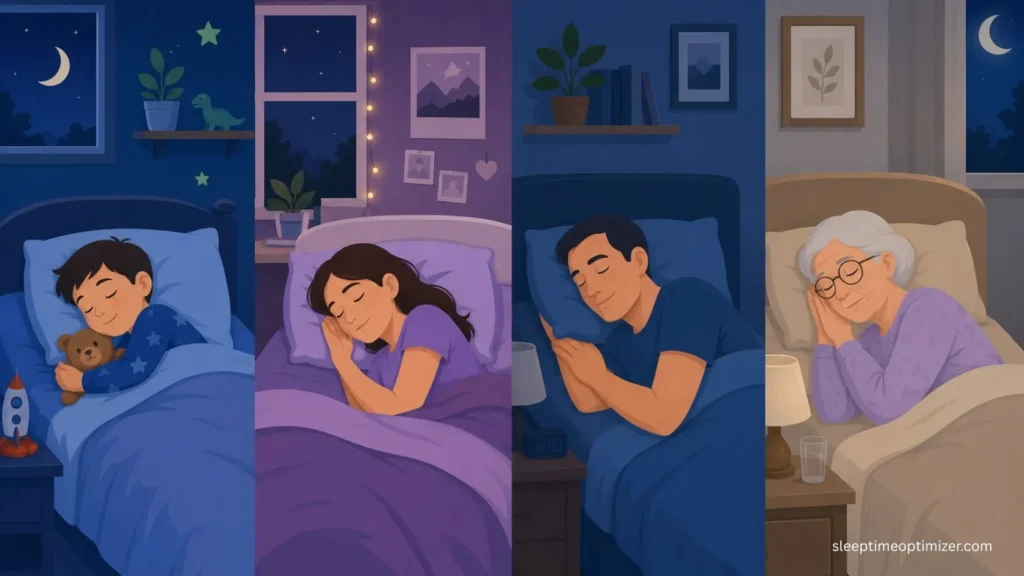
Your natural bedtime shifts over the course of your life – and significantly so. Teenagers experience a biological shift called delayed sleep phase, where melatonin release genuinely starts later at night (often around 11 p.m. or midnight). This isn’t laziness; it’s biology. Forcing a 16-year-old to sleep at 9 p.m. is a bit like asking them to fall asleep while their body is still in “daytime mode.”
As people move into their 20s and 30s, sleep timing tends to stabilize. Adults generally feel naturally sleepy somewhere between 10 p.m. and midnight. Older adults (65+) often shift earlier – feeling sleepy by 9 p.m. and naturally waking around 5 a.m. – a phenomenon called advanced sleep phase.
Here’s a rough guide based on age and a 7 a.m. wake-up:
| Age Group | Recommended Sleep | Ideal Bedtime (for 7 AM wake-up) |
| Teens (13–17) | 8–10 hours | 9:00 PM – 11:00 PM |
| Adults (18–64) | 7–9 hours | 10:00 PM – 12:00 AM |
| Older Adults (65+) | 7–8 hours | 9:00 PM – 10:30 PM |
Source: AASM sleep duration recommendations
What Actually Messes With Your Ideal Bedtime
A few things quietly shift your natural sleep window without you realizing it:
Caffeine. The half-life of caffeine is about five to six hours. A 3 p.m. coffee still has half its caffeine in your system at 8 or 9 p.m. – enough to delay your natural melatonin release and push your sleep window later.
Blue light from screens. The light emitted by phones, tablets, and laptops suppresses melatonin production. A 2015 Harvard study found that using a blue-light-emitting e-reader before bed delayed melatonin by about 90 minutes and shifted the circadian clock by 1.5 hours compared to reading a printed book.
Inconsistent wake times. Many people set different alarms for weekdays vs. weekends – sleeping in by two or three hours on Saturday and Sunday. This creates what researchers call social jetlag, which can shift your internal clock and make Monday mornings feel like flying from New York to London overnight.
Stress and cortisol. When you’re stressed, your body releases cortisol – a hormone that’s chemically the opposite of melatonin. High evening cortisol essentially fights your body’s natural sleep signal, keeping you alert when you’d otherwise be winding down.
A Practical System for Finding Your Bedtime
Rather than picking a random bedtime, here’s a simple approach:
- Anchor your wake time first. Decide what time you need to wake up, and keep that consistent every day – even weekends. This single habit does more for sleep quality than almost anything else.
- Count backwards in 90-minute blocks. From your wake time, subtract 90 minutes repeatedly until you reach a realistic bedtime. That’s your target. Aim to be in bed 15 minutes before that time, since the average person takes about 14-15 minutes to fall asleep.
- Run the experiment for two weeks. Sleep schedules take time to anchor. Most people feel a noticeable difference after 10–14 consistent nights.
- Use a calculator. Tools like Sleep Time Optimizer do this math instantly – factoring in your age, weight, and any health conditions that affect sleep duration.
The Honest Truth About Finding Your Bedtime
There’s no universal answer to what time should I go to sleep. A shift worker who clocks in at 6 a.m. has a very different ideal sleep window than someone who starts work at 10 a.m. A pregnant woman in her third trimester needs more sleep than the AASM’s general adult recommendation. A 65-year-old with mild sleep apnea has different constraints than a healthy 30-year-old.
What stays consistent across all of these cases is the underlying principle: align your sleep window with your natural melatonin rhythm, give your body enough time to complete four to six full cycles, and keep your wake time as consistent as possible.
Do those three things, and the next time you ask yourself what time should I go to sleep, you’ll have a real answer – not a guess.
→ Not sure what time works for your specific schedule? Try the Sleep Time Optimizer calculator – it factors in your age, wake time, and health conditions to give you a personalized bedtime recommendation in seconds.