You close your eyes, and roughly eight hours later you open them. Simple, right? Not even close. While you’re lying there looking peacefully unconscious, your brain is cycling through four distinct stages – repairing tissue, clearing toxic waste, consolidating memories, and regulating hormones. Understanding what actually happens in those cycles changes how you think about sleep entirely.
Sleep Is Not a Single State
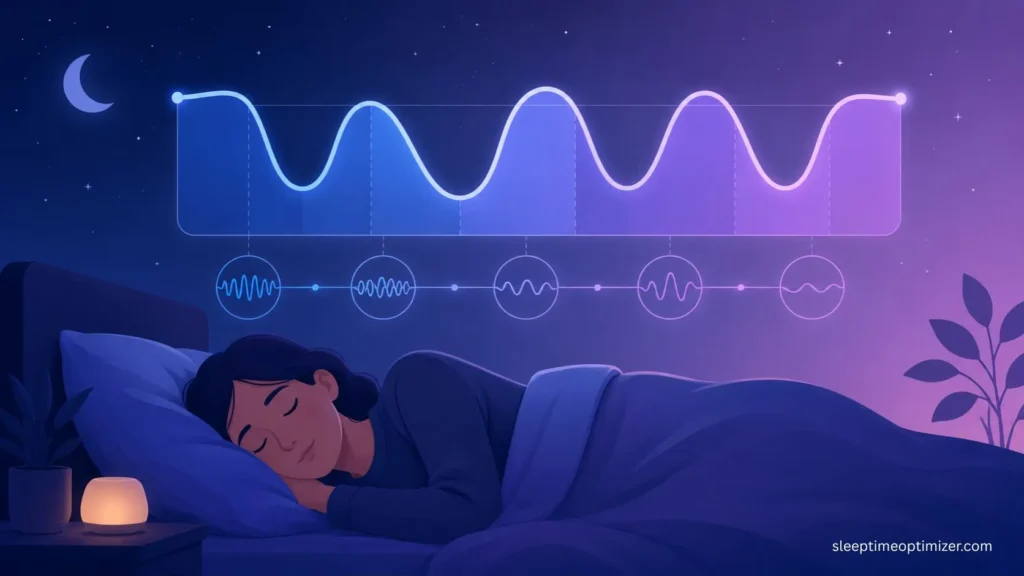
This is the thing most people get wrong. Sleep feels like one continuous event – you’re either awake or you’re not. But from your brain’s perspective, a night of sleep is more like a playlist that repeats four to six times, with each song being slightly different from the last.
Every time the playlist runs through – roughly every 90 to 110 minutes – that’s one complete sleep cycle. Most adults need four to six of these cycles per night, which maps to roughly six to nine hours of total sleep time.
Each cycle contains four stages: N1, N2, N3, and REM. They don’t repeat equally throughout the night. The first half of the night is weighted heavily toward deep sleep (N3). The second half tilts toward REM. This is why cutting your sleep short by even an hour or two can wipe out a disproportionate amount of your REM sleep – which is critical for memory and emotional health.
Stage 1 (N1) – The Entry Ramp (1–7 Minutes)
This is the lightest, most fragile stage of sleep. Your eyes are closed but you haven’t fully committed to being asleep. Your brain slows from its waking state (beta and alpha waves) into theta waves – a slower, drifting frequency. Muscles begin to relax, sometimes with that sudden jerk you feel as you’re falling asleep. That’s called a hypnic jerk, and it’s completely normal.
At this stage, you can be woken by almost anything – a door closing, a notification sound, your partner shifting in bed. You probably won’t even feel like you were fully asleep.
N1 is short (usually 1–7 minutes) and doesn’t do a lot of heavy lifting on its own. Its main job is transitioning you into deeper sleep.
Stage 2 (N2) – The Workhorse (10-25 Minutes)
N2 is where you spend the most total time across a full night – roughly 45–55% of your total sleep. It’s a medium-depth sleep stage where your heart rate slows, your body temperature drops, and your brain starts producing what researchers call “sleep spindles” – short bursts of brain activity at around 12–15 Hz that last half a second to two seconds.
Sleep spindles are fascinating. Research from MIT and elsewhere suggests they play a key role in memory consolidation – specifically, transferring information from short-term memory (held in the hippocampus) to long-term storage (in the cortex). Students who napped after learning new material showed significantly better memory retention when they had more sleep spindles during that nap compared to those who stayed awake.
This stage also features something called K-complexes – large, sharp brain waves that appear to suppress cortical arousal and help you stay asleep through minor disturbances.
Stage 3 (N3) – Deep Sleep / Slow-Wave Sleep (20–40 Minutes in Early Cycles)
This is the heavy-duty recovery stage, and it’s what most people are missing when they feel chronically tired.
N3 is characterized by slow delta brain waves (0.5–2 Hz). Your body is at its most relaxed – heart rate, breathing, and blood pressure are all at their lowest. If someone tried to wake you during this stage, you’d feel profoundly disoriented for several minutes.
Here’s what your body is actually doing during deep sleep:
- Tissue repair and muscle growth. The pituitary gland releases growth hormone almost exclusively during N3. A 2025 study from UC Berkeley published in the journal *Cell* identified specific neurons that trigger this growth hormone release during sleep, confirming that deep sleep is when the body literally builds and repairs itself.
- Immune function. Your immune system produces cytokines – proteins that regulate inflammation and fight infection – during deep sleep. This is why you feel exhausted when you’re sick. Your body is trying to get you into N3 so it can ramp up the immune response.
- Brain waste clearance. Your brain’s glymphatic system (essentially the brain’s waste-disposal network) becomes dramatically more active during deep sleep. This system flushes out metabolic waste products – including amyloid beta, a protein associated with Alzheimer’s disease. Chronic poor sleep in midlife is now considered a significant risk factor for Alzheimer’s by some researchers.
You get most of your deep sleep in the first two to three sleep cycles – the first half of the night. This is why going to bed at midnight and sleeping until 8 a.m. does not produce the same quality of sleep as going to bed at 10 p.m. and sleeping until 6 a.m., even though both are eight hours total. The early cycles contain longer deep sleep blocks.
Stage 4 (REM) – The Brain’s Office Hours (10–60 Minutes, Getting Longer Through the Night)
REM stands for Rapid Eye Movement – you can actually see the eyes darting back and forth under closed eyelids during this stage. It’s the stage most associated with vivid dreaming, and it shows up first about 70–90 minutes after you fall asleep.
During REM, your brain becomes remarkably active – close to waking levels. But your body is almost completely paralyzed (except for breathing and eye movement). This is thought to be a safety mechanism that prevents you from physically acting out your dreams.
What is REM actually doing for you?
Emotional memory processing. Your brain reviews and processes emotionally charged experiences during REM sleep, essentially extracting the emotional intensity from memories while preserving the informational content. People who are REM-deprived often show dramatically elevated emotional reactivity. This is partly why a bad night’s sleep makes everything feel harder and more upsetting.
Creative problem-solving. A well-documented phenomenon among researchers and artists alike: the brain often makes unexpected connections between disparate ideas during REM sleep. The structure of benzene was reportedly “seen” in a dream by chemist August Kekulé. Paul McCartney famously heard the melody of “Yesterday” in a dream. This isn’t coincidence – REM sleep appears to be when the brain allows looser, more associative thinking that conscious, analytical waking thought suppresses.
Learning consolidation. REM complements N2’s memory work by strengthening procedural memories – the kind involved in learning a new skill, a language, or a musical instrument.
Why the Cycle Structure Matters for Your Wake-Up
Because your sleep architecture is so structured – deep sleep up front, REM more heavily at the back – where you wake up in the cycle matters enormously to how you feel.
Waking up during N3 (deep sleep) is neurologically jarring. Your brain is running at its slowest, and being yanked out of that state produces a feeling researchers call “sleep inertia” – grogginess, confusion, and impaired performance that can last 15–60 minutes. If you’ve ever hit snooze three times, stumbled to the coffee maker, and still felt half-asleep by 10 a.m., that’s sleep inertia from waking mid-cycle.
Waking up during N1 or the tail end of a REM stage – which is what naturally happens when you complete a full cycle – feels much easier and cleaner. Your brain has already transitioned to a lighter state.
This is the core logic behind sleep cycle calculators: they help you time your alarm to land between cycles, not inside one.
→ Want to know exactly how many cycles you need and when to wake up? The Sleep Time Optimizer calculates your personalized sleep window based on your age, wake time, and health conditions.