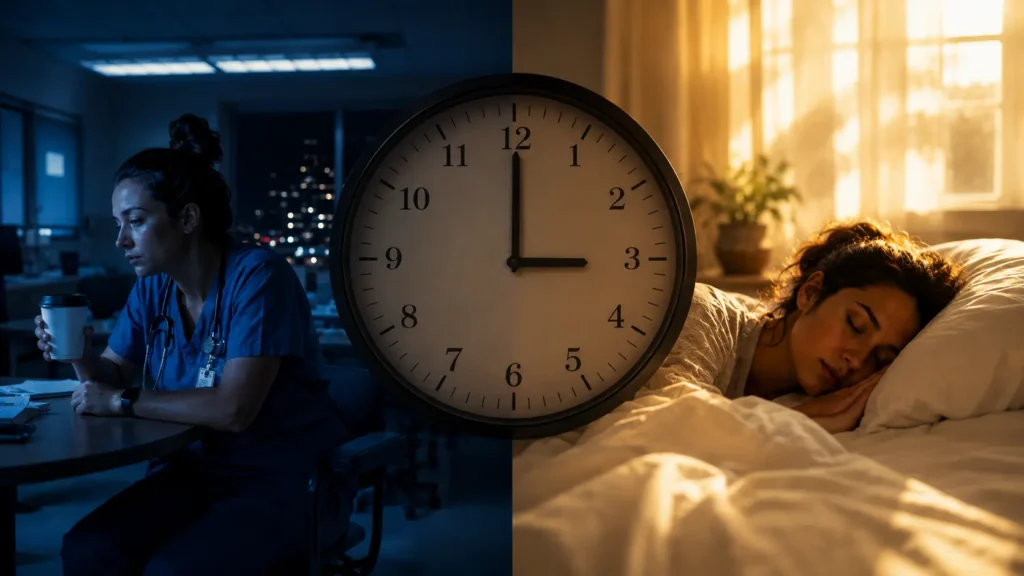
Standard sleep calculators are built around one assumption: you sleep at night and wake up in the morning. If you work nights, that assumption doesn’t apply – and the calculations break. This guide applies the same 90-minute cycle logic to night shift reality, with shift-specific sleep windows backed by actual research.
What Night Shift Actually Does to Your Sleep
Night shift workers aren’t just dealing with inconvenient hours. They’re running against three biological systems at once: daylight suppresses melatonin production, environmental noise peaks during the day, and the circadian rhythm keeps pushing toward wakefulness regardless of when the shift ended.
The numbers reflect this. A 2019 study published in Scientific Reports tracking 52 intensive care unit workers found that sleep was most restricted between consecutive night shifts, averaging just 5.74 hours – well below the 7-9 hours recommended by the American Academy of Sleep Medicine. CDC data from a survey of over 15,000 employed US adults found that 44% of night shift workers reported getting fewer than six hours of sleep daily, compared to less than 10% of day workers.
That sleep shortfall isn’t just about feeling tired. It compounds. The Scientific Reports study also found that workers showed measurably higher sleepiness scores and slower reaction times by the end of night shifts compared to day shifts – and that alertness was lowest on the first night of a run, before workers had a chance to partially adapt.
Your Sleep Window by Shift Type
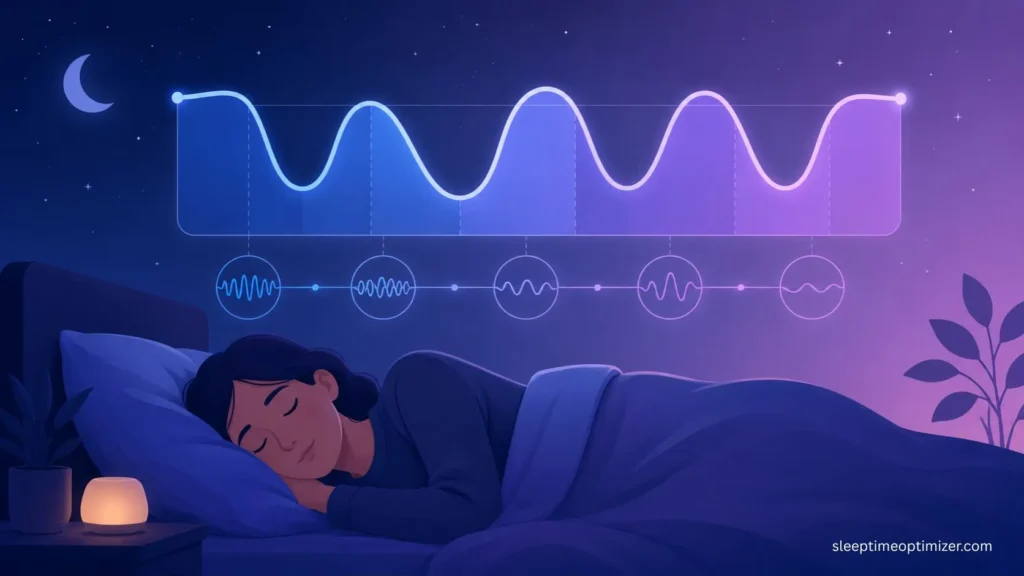
The core logic of a sleep calculator for night shift is the same as standard sleep timing: complete 90-minute cycles, ending at a natural light sleep transition rather than mid-deep sleep. What changes is the direction – you’re calculating from a daytime wake-up, not a morning alarm.
One practical rule before the tables: wait 60-90 minutes after shift end before trying to sleep. Going straight from a high-alert work environment to bed significantly delays sleep onset. A short wind-down period – even just eating, changing, and sitting quietly – meaningfully improves how quickly you fall asleep.
Standard Night Shift (11 PM – 7 AM or similar):
| Start Sleep | End Sleep | Cycles | Total |
| 8:30 AM | 4:00 PM | 5 cycles | 7.5 hrs |
| 8:30 AM | 5:30 PM | 6 cycles | 9 hrs |
| 9:00 AM | 3:00 PM | 4 cycles | 6 hrs (short-term only) |
12-Hour Night Shift (7 PM – 7 AM):
| Start Sleep | End Sleep | Cycles | Total |
| 8:30 AM | 4:00 PM | 5 cycles | 7.5 hrs |
| 8:30 AM | 5:30 PM | 6 cycles | 9 hrs |
8-Hour Night Shift (10 PM – 6 AM or 12 AM – 8 AM):
| Start Sleep | End Sleep | Cycles | Total |
| 7:30 AM | 3:00 PM | 5 cycles | 7.5 hrs |
| 8:00 AM | 2:00 PM | 4 cycles | 6 hrs (minimum) |
For a personalized calculation based on your age and health profile, use our free sleep calculator – enter your post-shift wake-up time as the “wake time” input. The 90-minute cycle math works for any schedule. See our sleep cycles guide to understand why cycle-aligned waking feels different from mid-cycle waking.
Split Sleep – A Research-Backed Alternative
Some night shift workers genuinely can’t sleep 7+ hours in a single daytime block. Family obligations, afternoon noise, and the body’s natural alertness window between 1-3 PM all work against it. Split sleep is a legitimate and researched alternative.
A 2014 study in Chronobiology International (Jackson et al., Vol 31, No 10) compared split sleep across a 5-day simulated workweek. Workers using a split schedule – two separate sleep blocks across 24 hours – averaged 7.16 hours of total sleep per day. Critically, this was significantly more than workers who attempted a single consolidated daytime block (6.4 hours average). The consolidated daytime group also reported the highest subjective sleepiness of the three conditions tested.
The takeaway: if one long block isn’t working, split sleep isn’t a fallback – it’s often a better fit for daytime sleep conditions.
Option A: Anchor + Top-Up (Best for family schedules)
- Main block: 8:30 AM – 1:30 PM (5 hours)
- Pre-shift nap: 5:30 PM – 7:00 PM (90 minutes – one complete cycle)
- Total: 6.5 hours across two blocks
Option B: Single Long Block (Best for controlled environments)
- Sleep: 8:30 AM – 4:00 PM (7.5 hours, 5 cycles)
- Requires blackout curtains, household agreement, and phone on Do Not Disturb
Option A suits workers with children or afternoon commitments. Option B produces better sleep architecture but demands a more controlled environment.
Making Daytime Sleep Actually Work
A sleep calculator for night shift only delivers results if the sleep environment cooperates. Most shift workers lose 1-2 hours of potential sleep not from the schedule itself, but from a bedroom that fights them.
Blackout curtains – the single highest-impact change. A 2022 study from Northwestern University (Mason et al., PNAS) found that even moderate light exposure during sleep measurably increased next-morning heart rate and insulin resistance compared to complete darkness. Standard curtains don’t block summer sunrise (which can hit before 5 AM). True blackout curtains rated at 99%+ light blocking eliminate this problem entirely.
White noise. Daytime ambient noise from traffic and neighborhood activity typically runs 60-70 dB. Sleep researchers recommend keeping bedroom sound below 40 dB for uninterrupted sleep. A white noise machine set to 50-55 dB masks variable noise without creating its own sleep disruption.
Temperature below 68°F (20°C). Your core body temperature needs to drop slightly to initiate deep sleep. Daytime temperatures – especially in summer – often sit above this threshold. A fan or small AC unit running throughout your sleep block makes a measurable difference.
Household communication. Write the schedule down – a specific sign on the door (“Sleeping 8:30 AM – 4:00 PM”) works better than verbal requests. Vague asks get forgotten; specific posted times usually don’t.
Rotating Shifts – The Harder Problem
Rotating shifts – cycling between day, evening, and night schedules – present a different challenge than fixed nights. The circadian rhythm can never fully stabilize when the schedule keeps changing.
The scale of the problem is documented. According to NIH data compiled in StatPearls, 10%-38% of shift workers develop shift work sleep disorder (SWSD) – defined as clinically significant insomnia or excessive sleepiness directly linked to work scheduling. Among workers on rapidly rotating schedules, one study cited by MedLink Neurology put the SWSD rate as high as 63%. A 2017 paper by Wan-Ju Cheng in Occupational and Environmental Medicine further confirmed associations between shift work and sleep problems, burnout, and minor mental health disorders – with rotating and night schedules showing elevated risk compared to fixed day work.
A sleep calculator for night shift helps rotating shift workers identify optimal sleep windows for each phase, but the constant resetting means the circadian rhythm never anchors. Practical strategies that reduce the impact:
Request forward-rotating schedules. Day > Evening > Night is significantly easier than Night > Day. The body naturally drifts later, so forward rotation works with that tendency. Backward rotation (moving to earlier schedules) forces the clock against its natural direction and produces worse sleep and performance outcomes.
Don’t fully switch back on days off. Shifting sleep time, no more than 2-3 hours from your work schedule on rest days reduces the transition shock. A full reversal to normal sleeping on days off means your body is essentially crossing 8-10 time zones twice per week.
Light therapy lamps. A 10,000-lux lamp used strategically – in the evening before night shifts to delay your clock, or in the morning to advance it for a return to days – directly shifts melatonin timing. This is one of the few interventions that addresses the circadian cause rather than just the symptoms.
The Long-Term Picture
This isn’t here to discourage shift work – most shift workers manage it throughout long careers. But the research is clear enough to take seriously.
The World Health Organization classified night shift work as a probable carcinogen (Group 2A) in 2007, based on evidence of disrupted melatonin cycles and circadian misalignment. Shift work is also associated with elevated metabolic syndrome risk, cardiovascular disease, and insomnia prevalence 29-38% – compared to approximately 6% in the general population (NIH StatPearls).
The practical upshot: for shift workers, sleep optimization is protective health behavior, not just comfort. Protecting your sleep window, maintaining consistency, and hitting 7+ hours most nights reduces – though doesn’t eliminate – the physiological cost of the schedule.
Understanding how many hours you need and what actually happens in each sleep cycle gives you the context to make better decisions about your window.
Frequently Asked Questions
Q: How much should I sleep if I work night shift?
Answer: The AASM recommendation – 7 to 9 hours for adults – applies regardless of shift timing. The goal doesn’t change; the window does. Using a sleep calculator for night shift identifies where those hours fall in your post-shift day. For most 7 AM shift-end workers, the 8:30 AM – 4:00 PM window covers 5 complete 90-minute cycles.
Q: Can I only sleep 4 hours after a night shift?
Answer: Four hours covers roughly 2.5 sleep cycles and leaves most people in meaningful sleep debt if it’s a regular pattern. If 4 hours is all a given day allows, pairing it with a 90-minute pre-shift nap (one full cycle, ending 30+ minutes before work to clear sleep inertia) is more effective than relying on those 4 hours alone. Chronically sleeping 4 hours on night shift accumulates into serious cognitive impairment within weeks.
Q: What is the 3-3-3 rule for sleep?
Answer: The 3-3-3 rule refers to cutting caffeine 3 hours before sleep, alcohol 3 hours before sleep, and food 3 hours before sleep. For night shift workers: no caffeine in the last 3 hours of your shift, no alcohol immediately after your shift before sleeping, and no heavy meals right at shift end. These three alone reduce the time it takes to fall asleep during the day.
Q: Should I stay on my night shift sleep schedule on days off?
Answer: Maintaining roughly the same schedule on days off preserves your circadian rhythm and reduces re-adaptation when returning to nights. Full consistency is rarely practical. A realistic middle ground: allow no more than a 2-hour shift in sleep timing on rest days. A full reversal to normal night sleeping on days off means your body re-adjusts twice a week – which most people underestimate the cost of.
Q: Is there a free sleep calculator for night shift workers?
Answer: Our sleep calculator works for any wake-up time. Enter your post-shift wake time as the target, and it returns cycle-aligned sleep start times based on your age and health profile. The underlying 90-minute cycle math is schedule-agnostic – it works whether you’re sleeping at 9 PM or 9 AM.
Also useful: Why You’re Tired After 8 Hours Sleep – sleep quality issues are significantly more common in shift workers, and the causes overlap directly with the environment and timing problems covered here.
Best Sleep Time: What Science Says – understanding the biology of sleep timing explains why a consistent shift-sleep window outperforms a variable one, even when total hours look the same.